What High-Mix, Low-Volume Automation Really Requires
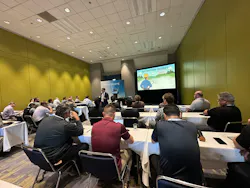
At 8:30 on a Monday morning, Jerry Perez had a challenging assignment: Make a conference session on high-mix, low-volume cobot applications worth waking up for.
The executive director of global accounts, FANUC America, opened his Automate 2026 session with a “Fight Club” analogy: “The first rule of high-mix, low-volume is, we don't talk about high-mix, low-volume.”
The provocative line set the tone for a presentation that challenged some of the assumptions surrounding cobots and flexible automation. High-mix, low-volume manufacturing, he argued, is too broad a label to tell engineers whether a robot is the right fit. Instead, manufacturers need to look at the details, including the parts involved, the degree of variation, cycle times and the tasks current operators are performing.
READ MORE: The Robots Are Getting Real: Lessons from Hannover Messe’s Industrial AI Reality
Throughout the presentation, Perez, a robotics leader whose experience spans defense, automotive and medical device manufacturing, used a series of memorable phrases to underscore his main points. Speaking to an audience ranging from first-time cobot adopters to chemists hoping to automate lab applications, he focused on what it really takes to automate high-mix, low-volume operations.
The presentation offered no shortage of memorable one-liners, but each served a purpose. The three quotes below capture the lessons he hoped manufacturers would take away.
Perez framed much of his presentation around a familiar principle: “Measure twice, cut once.” Applied to automation, that means doing the necessary upfront work to understand the application and identify potential pitfalls before selecting a robot or automation strategy.
For Perez, prework is the foundation of successful deployment. Rather than focusing on SKU counts, Perez said manufacturers should examine what actually changes from part to part. That analysis should include part characteristics, cycle times, quality requirements and manual work instructions for each part type.
This distinction matters because a facility may have thousands of SKUs without requiring the robot to perform thousands of unique robotic operations. If products can be grouped into a limited number of part families with similar sizes, geometries or handling requirements, the application may be more automatable than the raw SKU count suggests.
Quote: “There’s no such thing as collaborative robots.”
Lesson: Start with the application.
Perez called out a blind spot in the perception of what cobots bring to an automation project. Their advantages—being easier to program, lighter and more flexible than industrial robot installations—can create the impression that they are simply easy to deploy.
In reality, a significant amount of engineering and integration work may be required before an application can reach the automation starting line. Manufacturers may need to unpack and mount the robot; connect hardware; configure the TCP (tool center point); and account for the payload, inertia and safety setting. This is especially challenging for manufacturers new to high-mix, low-volume automation, where some of the biggest hurdles are “unknown unknowns” and these requirements may not become apparent until the deployment process is underway.
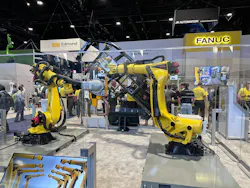
Safety is another critical consideration where a robot may need to accommodate frequent changeovers or work alongside other equipment and people. Perez noted that many users assume the term “cobot” implies human-safe operation. In reality, whether an installation can operate collaboratively depends on the application and how the complete system is designed, integrated and assessed, not the robot arm alone.
The better question, according to Perez, is whether the system can create a situation in which someone could be injured and then design the application accordingly. “There is no such thing as a collaborative robot; there is a collaborative application,” he reiterated, referring to recent revisions to ISO 10218 and ANSI/A3 R15.06, which shift from labeling a machine as a “cobot” to evaluating the collaborative application. In the revised standards, safety is determined by the design and risk assessment of the complete application, rather than the arm alone.
When an audience member asked why one might choose a cobot if the application still requires guarding, Perez challenged the assumption that guarding eliminates the advantages of a cobot. Instead, he directed the audience to consider what the robot brings to the application.
Features such as lead-through teaching, a lighter and more mobile form factor, and simplified programming remain valuable advantages, even in a guarded installation. For example, FANUC's CRX platform supports manual guided teaching and tablet-based programming, with models operating from standard 100–120-V or 200–240-V power.
Quote: “Don’t target the 100%.”
Lesson: Start smaller than the problem.
Automation solutions range from DIY tinkerer setups to assisted mobile carts and fully pre-engineered, turnkey application cells, noted Perez. The right choice, he argued, depends not only on the application but also on the level of internal expertise and engineering resources available.
For high-mix environments new to automation, for example, Perez suggested a pragmatic approach that focuses on “high runners” or top-part families rather than attempting to automate thousands of SKUs at once. In many cases, a relatively small subset of products accounts for a significant share of production volume. Automating that portion first can provide a lower-risk entry point while helping engineers build experience with robotics, tooling and process integration, Perez explained.
READ MORE: The Evolution of Cobots and Single Pair Ethernet (SPE)
The same thinking applies to automation goals. A system does not necessarily have to replace 100% of a manual process to deliver value. To get started, you don't have to automate the entire factory or even the entire application, Perez said. The first successful deployment may simply be the one that gives engineers a practical foundation for tackling the next one.
Understanding the Work Comes First
FANUC’s Cobot and Go exhibit provided the commercial backdrop for the session, highlighting the company's push toward pre-engineered, application-specific systems designed to reduce deployment complexity.
But Perez’s central message extended beyond any single product. Automation success begins long before a robot is selected. As manufacturers gain access to an expanding range of automation options, upfront work may do more to determine the outcome than the technology they ultimately deploy.
More content from Takeover Week: Automation & Robotics.
About the Author
 Rehana Begg
Rehana Begg
Editor-in-Chief, Machine Design
As Machine Design’s content lead, Rehana Begg is tasked with elevating the voice of the design and multi-disciplinary engineer in the face of digital transformation and engineering innovation. Begg has more than 24 years of editorial experience and has spent the past decade in the trenches of industrial manufacturing, focusing on new technologies, manufacturing innovation and business. Her B2B career has taken her from corporate boardrooms to plant floors and underground mining stopes, covering everything from automation & IIoT, robotics, mechanical design and additive manufacturing to plant operations, maintenance, reliability and continuous improvement. Begg holds an MBA, a Master of Journalism degree, and a BA (Hons.) in Political Science. She is committed to lifelong learning and feeds her passion for innovation in publishing, transparent science and clear communication by attending relevant conferences and seminars/workshops.
Follow Rehana Begg via the following social media handles:
LinkedIn: @rehanabegg and @MachineDesign
YouTube: @MachineDesign-EBM
Voice Your Opinion!
To join the conversation, and become an exclusive member of Machine Design, create an account today!
 Leaders Logo
Leaders relevant to this article: